The geotechnical contrast between a Waikiki high-rise and a hillside residence in Manoa defines anchor design in Honolulu. Waikiki often rests on compressible marine clays and coral debris overlying cemented calcareous sand, demanding passive anchors that mobilize friction in low-strength coastal deposits. Manoa's volcanic basalt saprolite, however, allows for high-capacity active tendons bonded into rock with short bond lengths. Designing a ground anchor system without recognizing that Oahu's subsurface can shift from stiff residual soil to fractured Koolau basalt within a single block leads to either overdesigned sections or insufficient restraint. Our team correlates site-specific stratigraphy with the load-transfer requirements of each anchor type, ensuring the restraint system fits the actual ground model rather than a generic assumption.
An anchor's capacity in Honolulu is dictated less by steel strength and more by the grout-to-ground bond within variably weathered Koolau basalt.
Scope of work in Honolulu
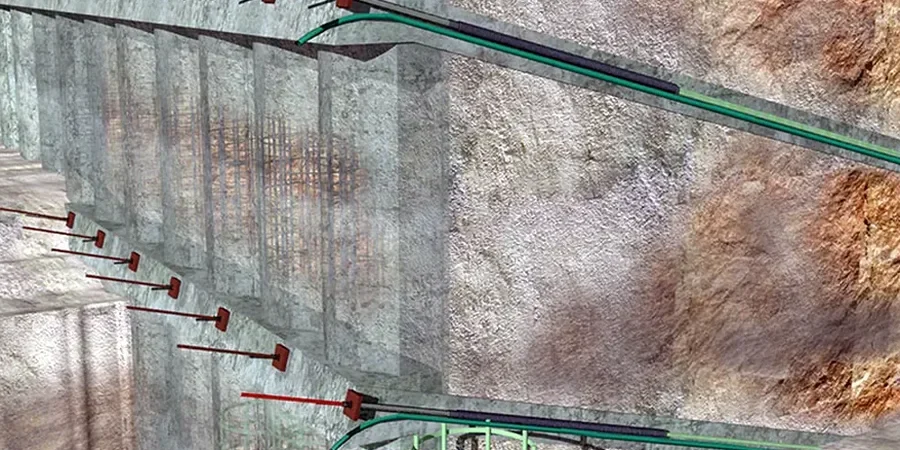
Typical technical challenges in Honolulu
Honolulu's growth from a collection of low-rise plantation structures to a dense coastal metropolis placed significant demand on excavated space. Early developments in the 1960s and 1970s along Kapiolani Boulevard cut into old coral bluffs using soldier pile walls with minimal tieback reinforcement, and several of these legacy walls now show distress through excessive deflection and spalling. The risk today is compounded when new deep excavations adjoin these aging retention systems: installing high-pressure active anchors within 10 feet of a corroded passive wall can trigger uncontrolled relaxation and differential settlement. In the McCully-Moiliili basin, the presence of a shallow groundwater table, which fluctuates with irrigation and tide, accelerates corrosion of underprotected strand. Without a corrosion protection class rated for aggressive tropical soils, anchor tendons lose section within a decade, rendering the restraint system ineffective before the structure reaches its service midpoint.
Our services
Our Honolulu anchor programs cover the full lifecycle from feasibility to lock-off, adapted to the island's basalt and coastal soil profiles.
Active Anchor Design and Proof Testing
We design post-tensioned anchors for retaining walls and deep excavation support in Honolulu's volcanic terrain, including load-transfer analysis in fractured basalt, creep testing per IBC 1810, and lift-off verification after lock-off to confirm residual load.
Passive Anchor and Soil Nail Systems
For cuts in residual soil and stiff alluvium on Oahu, we specify grouted passive bars that mobilize resistance through progressive deformation, with pull-out testing on sacrificial nails to validate the grout-to-ground bond in tropical saprolite.
Questions and answers
How much does an active/passive anchor design cost for a Honolulu project?
Design and testing programs typically range from US$950 to US$3,370, depending on the number of anchors, required corrosion protection class, and whether on-land or near-shore access conditions apply. A site-specific proposal is provided after reviewing the geotechnical report and wall elevation drawings.
What corrosion protection level is required for ground anchors in Honolulu?
We generally specify Class II protection (encapsulated strand) for permanent anchors in Honolulu's tropical soils, where chloride-laden marine aerosols and acidic volcanic groundwater accelerate steel deterioration. For critical structures, Class I protection with double corrugated sheathing is recommended per PTI DC-35.
How is anchor bond length determined in Koolau basalt?
Bond length depends on the rock mass rating of the basalt and the allowable grout-to-ground bond stress. We typically begin with a presumptive bond of 150 to 300 psi in moderately weathered basalt, then refine the value through field pull-out tests on sacrificial anchors installed at the project site.
Do you perform lift-off testing after anchor lock-off in Oahu?
Yes, lift-off testing is standard practice on our Honolulu projects to verify that the residual load matches the design lock-off load within 5%. This is especially important in residual soils where relaxation can occur due to secondary consolidation of the volcanic saprolite. More info.