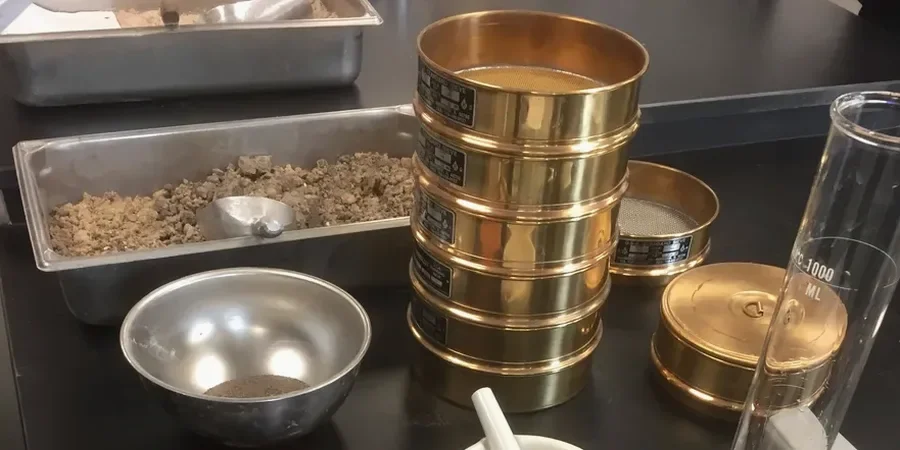
On any Honolulu jobsite, whether it's a hillside residential lot in Kaimuki or a commercial build-out in Kakaako, the soil rarely fits a textbook profile. We've seen too many projects stall because someone assumed a uniform sand and ended up with a gap-graded silty mix that wouldn't compact. A complete grain size analysis strips out that guesswork. By running the full stack—coarse sieves down to the No. 200 and a hydrometer for the fines fraction—we map every particle group present. That data feeds directly into USCS classification per ASTM D2487, giving your structural engineer the right input for bearing capacity, drainage design, and liquefaction screening under ASCE 7. For basalt-derived residual soils common above the H-1, the fines content alone often decides whether you need ground improvement or can proceed with shallow footings.
In Honolulu's mixed basaltic and coralline soils, fines content often makes the difference between a straightforward footing and a costly ground improvement program.
Scope of work in Honolulu
Typical technical challenges in Honolulu
Honolulu's geology throws two particular curveballs at gradation-dependent design: the presence of coralline sand lenses in coastal plain deposits and the highly variable weathering profile of the Ko'olau basalt series. Coralline sands can crush under compaction, shifting the gradation mid-project and altering the design permeability of drainage blankets beneath Ala Moana area structures. Up-slope, the transition from saprolite to hard basalt can happen within 3 vertical feet, meaning two samples from the same test pit can produce wildly different gradation curves. The IBC-mandated 5-foot deep soil investigation minimum won't always catch that. A grain size analysis run on every distinct stratum, not just a composite, is the only way to avoid surprises during excavation or undercutting. When the gradation flags a gap-graded or poorly graded soil, we typically recommend follow-up triaxial testing to quantify strength under the actual in-situ density and saturation conditions expected at the site.
Our services
Our Honolulu lab runs both standard and specialized grain size programs. Whether the project is a single-family home needing a fast classification or a multi-phase commercial development requiring full hydrometer curves on dozens of samples, the workflow is built for clarity and turnaround.
Full Sieve + Hydrometer Package
Combined ASTM D6913 and D7928 analysis. Wash-sieve through No. 200, oven-dry, then hydrometer on the fines. Delivers a complete particle size distribution curve, USCS classification, and all derived coefficients. Suitable for foundation investigations, drainage design, and liquefaction screening across Honolulu County.
Project-Specific Batch Processing
For larger Oahu developments—subdivisions, school campuses, sewer alignments—we process sample batches with shared QA/QC. Includes duplicate runs, reference material checks, and a summary table correlating gradation with USCS group symbols. Turnaround paced to your excavation submittal schedule.
Questions and answers
How much does a grain size analysis with hydrometer cost in Honolulu?
A standard combined sieve and hydrometer test per ASTM D6913/D7928 typically runs between US$100 and US$210 per sample, depending on whether we also need to run parallel Atterberg limits or if the material requires special dispersion. Batch pricing is available for projects with five or more samples.
How long does the hydrometer portion take?
The hydrometer sedimentation test is time-dependent and typically runs over a 24-hour period, with readings taken at specific intervals per ASTM D7928. After data reduction, the combined sieve and hydrometer report is usually delivered within 3 to 5 business days from sample receipt.
Do these results satisfy Honolulu building permit requirements?
Yes. Our reports cite ASTM D6913, D7928, and D2487, which are the accepted standards under the IBC and Honolulu's building code amendments. The USCS classification and gradation parameters provided meet the geotechnical report requirements for foundation, retaining wall, and grading permits across Oahu.
Can you test coral sand or highly crushed basalt?
Coral sands and crushable basaltic gravels require careful handling because particle breakdown during sieving can skew the results. We adjust the mechanical sieve shaking time and, where appropriate, run a companion test on a lightly hand-sieved split to quantify crushability. The report notes any deviation from standard procedure so the design engineer can account for particle breakage.