A mid-rise condominium project near Ala Moana Boulevard encountered a classic Honolulu problem: loose calcareous sand lenses at 12 to 18 feet, sitting right above a stiffer basalt-derived saprolite. The structural engineer had specified a mat foundation, but the differential settlement risk across the loose pockets was unacceptable. The developer brought us in to design a vibrocompaction program that could densify those specific zones without over-compacting the surrounding material. In Oahu’s coastal plain, where the water table sits high and the subsurface alternates between coralline debris, marine clay, and weathered volcanics, generic compaction methods fail. A properly engineered vibrocompaction plan—one that accounts for the grain-size distribution from an in-situ permeability test and the real-time response of the soil—is what turns a marginal site into buildable ground. Honolulu’s construction pace demands that kind of precision.
A vibrocompaction design built on Hawaii-specific stratigraphy consistently achieves 70 percent relative density in coralline fills, eliminating differential settlement before the first yard of concrete is poured.
Scope of work in Honolulu
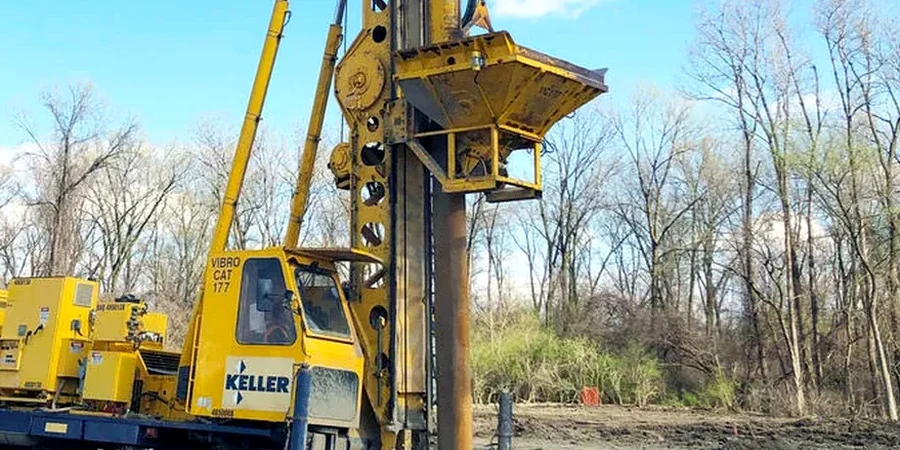
Typical technical challenges in Honolulu
The most common mistake in Honolulu is treating vibrocompaction as a procurement item instead of a design item. Contractors who bid on probe spacing without a site-specific design often leave untreated lenses exactly where the foundation will impose its highest bearing pressure. We’ve seen this in Waikīkī, where a hotel addition required re-compaction after the initial grid missed a 4-foot layer of loose fill at the 20-foot depth. The rework cost nearly double the original ground-improvement budget. Another risk is ignoring the interaction between vibrocompaction and the high groundwater table that sits just 3 to 6 feet below grade in much of Honolulu’s coastal zone. If the design doesn’t account for pore-pressure dissipation rates, the compaction energy can simply displace water rather than densify the soil. A third failure mode arises when designers apply mainland gradation criteria to Hawaiian coralline sands, which crush under vibratory energy differently than silica sands. Our designs include a crushability assessment and adjust the compaction energy curve accordingly, avoiding the over-treatment that can actually reduce permeability and create drainage problems under the slab.
Our services
Our vibrocompaction design services for Honolulu projects cover the full lifecycle from feasibility assessment through post-treatment verification. We deliver a site-specific package that the specialty contractor can execute without ambiguity.
Site-Specific Vibrocompaction Design
We develop the probe layout, energy schedule, and treatment depth for your Honolulu site based on CPT logs, grain-size analysis, and groundwater monitoring. The package includes a quality-control plan with pass/fail criteria tied to post-compaction CPT testing.
Post-Treatment Verification and Compliance Reporting
After the contractor completes the vibrocompaction program, we run a verification campaign using CPT soundings at pre-defined grid points. The report compares pre- and post-treatment tip resistance and friction ratio, confirming that the specified relative density has been achieved across the full treatment zone.
Questions and answers
How much does a vibrocompaction design for a Honolulu site typically cost?
For a standard residential or commercial lot in Honolulu, the vibrocompaction design fee ranges from US$1,680 to US$4,460, depending on the treatment area, depth, and the number of CPT verification points required. Larger multi-building projects on fill sites near the coast will fall toward the upper end of that range due to the additional subsurface investigation and reporting effort.
How do you verify that the vibrocompaction actually densified the soil?
We run pre-treatment and post-treatment CPT soundings at identical locations across the grid. The increase in cone tip resistance and sleeve friction is correlated to relative density using published relationships for Hawaiian calcareous and volcanic sands. We also monitor probe ammeter data and water-pressure response during compaction to confirm that the energy is being absorbed by the soil rather than dissipated through the groundwater.
What soil types in Honolulu are suitable for vibrocompaction?
Vibrocompaction works best in granular soils with less than 15 percent fines passing the #200 sieve. In Honolulu, that includes the coralline sand fills common in Kaka’ako, Ala Moana, and Waikīkī, as well as the cleaner volcanic sands found in parts of the Ewa Plain. If the fines content is higher, we may recommend complementary techniques such as stone columns or a different ground improvement method.