Honolulu sits on a complex geological mosaic where ancient basaltic lava flows meet marine sediments and coralline fill. The city’s average annual rainfall of roughly 17 inches on the leeward side creates moisture conditions that directly affect the strength of these volcanic residual soils. For any pavement or highway project on Oahu, the laboratory California Bearing Ratio test remains the standard method to quantify subgrade stiffness and determine structural layer thicknesses. Our lab processes disturbed and undisturbed samples from across Honolulu County—from the Koolau foothills to the coastal plain—using soaked CBR protocols that replicate the saturated conditions common during winter Kona storms. Results feed directly into the AASHTO 1993 pavement design guide and the Hawaii Department of Transportation specifications.
A soaked CBR below 3% in Honolulu’s plastic clays typically requires a minimum 300 mm subbase replacement before asphalt paving.
Scope of work in Honolulu
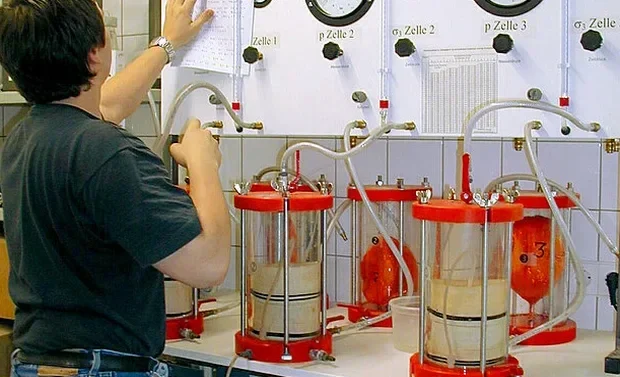
Typical technical challenges in Honolulu
Honolulu’s elevation ranges from sea level to over 1,200 meters in the Koolau Range, but most infrastructure sits below 15 meters elevation on coastal sediments with a shallow water table. The city’s last significant seismic event, the 2006 Kiholo Bay M6.7 earthquake, produced peak ground accelerations that highlighted the vulnerability of saturated fills. A CBR lab test that skips the 96-hour soaking phase will overpredict subgrade strength by 40 to 60 percent in these moisture-sensitive soils. The real risk emerges after the first heavy rainy season, when unsoaked design values lead to premature rutting and pavement fatigue cracking. Honolulu’s combination of tropical rainfall, high groundwater, and expansive volcanic clays makes the fully soaked CBR protocol non-negotiable for defensible pavement design.
Our services
We provide a complete testing sequence for Honolulu pavement projects, from field sampling to calibrated lab analysis. Each service follows AASHTO and HDOT requirements:
Soaked Laboratory CBR
Four-day submersion test with swell measurement and load-penetration curve up to 12.5 mm, reported with 95% and 98% compaction curves.
CBR-Resilient Modulus Correlation
Conversion of soaked CBR values to Mᵣ using local Oahu correlations validated for volcanic silty clays and coral-derived granular fills.
Questions and answers
What is the typical turnaround time for a soaked CBR test in Honolulu?
The full soaked CBR procedure requires five working days: one day for specimen compaction and setup, plus 96 hours of continuous submersion. The penetration test and report are completed on the fifth day. For urgent projects we can run a parallel set of specimens to reduce calendar time.
How much does a laboratory CBR test cost?
A single-point soaked CBR test ranges from US$120 to US$190 depending on the number of compaction points and whether swell measurement is included. A three-point CBR curve for moisture-density relationship typically falls between US$340 and US$500.
Does HDOT require soaked or unsoaked CBR values?
The Hawaii Department of Transportation requires soaked CBR values for all flexible pavement design. Unsoaked values may be reported as supplementary data but cannot substitute the soaked result in the structural design package for public roadways.
Can you test coral sand and basaltic gravel with the same CBR mold?
Yes, the standard 152 mm mold accommodates both fine-grained volcanic soils and granular coral materials. For material with particles larger than 19 mm, we use a 229 mm diameter mold following the AASHTO T 193 procedure for oversized material.
What CBR value is considered acceptable for Honolulu residential streets?
Honolulu city standards typically require a minimum soaked CBR of 5% for local residential streets with light traffic. Arterial roads and commercial parking lots often demand 8% or higher. Values below 3% trigger mandatory subgrade stabilization or geogrid reinforcement. More info.