We have seen too many Honolulu projects stall because the soil report was a generic copy-paste job that missed the thin lens of soft clay or the loose coral sand layer at 15 feet. On an island where the geology shifts from basalt to calcareous sand within a single parcel, skipping a proper Standard Penetration Test is a gamble with your foundation budget. The SPT gives you the N-value right at the depth where your footings will sit, which is the only way to size them correctly under ASCE 7 and the Honolulu building code. For deeper profiling in the coastal plain, we often pair the SPT with a CPT test when the stratigraphy needs continuous electronic logs without sample disturbance.
An uncorrected N-value in Honolulu's calcareous sands can overstate bearing capacity by 30 percent. We correct for hammer energy and overburden so your structural engineer designs on real numbers, not assumptions.
Scope of work in Honolulu
Live process video
Typical technical challenges in Honolulu
One pattern we notice on Oahu is that contractors sometimes treat the SPT as a commodity and hire the lowest bidder who shows up with an uncalibrated safety hammer and a worn-out rope. The result is a blow count that is inflated by 10 to 20 percent because of excess friction, and the foundation ends up undersized for the actual soil stiffness. In lava-ridden terrain near Diamond Head or Hawaii Kai, refusal on basalt floaters can happen above 50 blows, and an inexperienced driller might call that bedrock when it is really just a boulder sitting in soft ash. That misclassification cascades into a pile design that is both expensive and unnecessary. The other local risk is liquefaction: the loose sandy fills along the Ala Wai Canal and the airport reclaimed lands need SPT-based liquefaction triggering analysis, and if the boring log does not capture the exact depth of the loose zone, the seismic risk assessment for the structure is incomplete.
Our services
A single SPT boring answers the immediate bearing capacity question, but most Honolulu projects need a layered investigation to cover slope conditions, groundwater, and lateral earth pressures. The following services round out the subsurface picture.
SPT Drilling Package
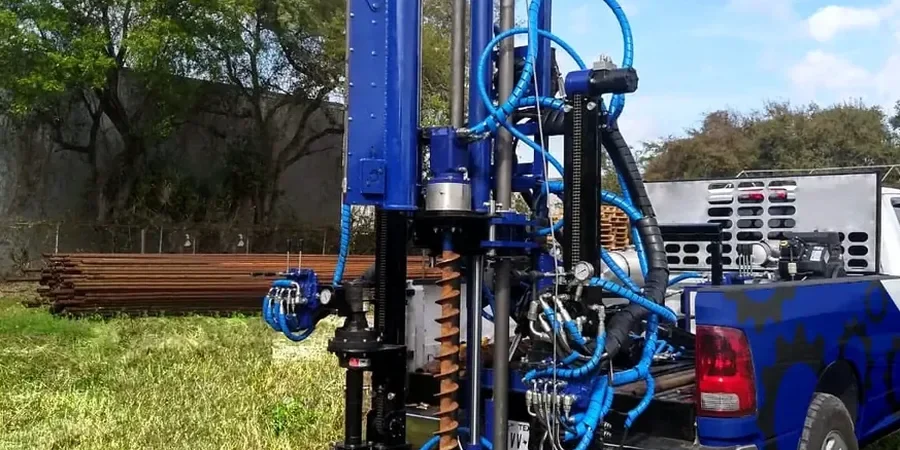
Truck-mounted or portable track rig SPT borings with automatic hammer. Includes N60 and N1(60) corrected blow counts, USCS soil classification from split-spoon samples, groundwater observation, and a signed geotechnical boring log ready for your structural engineer.
Liquefaction Screening
SPT-based liquefaction potential analysis using Seed & Idriss simplified procedure. We compute factor of safety against liquefaction for each loose sand or silt layer and estimate post-liquefaction settlement, as required by the Honolulu building department for sites in seismic design category D and E.
Foundation Recommendation Report
We translate SPT N-values into allowable bearing capacity, estimate total and differential settlement, and provide preliminary foundation type recommendations (spread footings, mat, or deep foundations). Report is sealed by a Hawaii-licensed professional engineer.
Questions and answers
How much does an SPT boring cost in Honolulu?
For a standard SPT boring to 30 feet depth with full logging and lab classification, the cost typically falls between US$490 and US$760 per boring, depending on access, rig mobilization distance, and the number of samples recovered. Deeper borings or sites requiring a portable track rig in tight residential lots may increase the mobilization charge, but we provide a fixed-price proposal after reviewing your site address and project scope.
How many SPT borings does the Honolulu building department require?
The City and County of Honolulu generally follows IBC Section 1803, which requires at least one boring per 1,600 square feet of building footprint for structures on shallow foundations, with a minimum of two borings per site. For larger commercial projects or sites with known variable geology, the structural engineer may specify additional borings to capture lateral variability.
Can you drill through basalt with an SPT rig?
The split-spoon sampler is not designed for rock coring, and basalt refusal will stop the SPT test. In areas like Kaimuki or Hawaii Kai where basalt is shallow, we switch to a core barrel and log the rock quality designation (RQD) once refusal is met. The SPT log will note the depth and blow count at refusal, and the rock core data becomes a separate appendix in the geotechnical report.
What is the difference between N-value and N60?
The raw N-value is the number of blows per foot read directly from the field. N60 is the same blow count corrected to 60 percent of the theoretical free-fall hammer energy, per ASTM D1586. In Honolulu, where many rigs use automatic hammers with energy transfer ratios around 75 to 90 percent, the correction can reduce the raw N by 10 to 20 percent. N1(60) goes one step further and removes the effect of overburden pressure, which is essential for liquefaction analysis and for comparing soils at different depths.