With over 340,000 residents and infrastructure that must withstand everything from tropical storms to the steady corrosion of salt air, Honolulu demands precise geotechnical verification on every project. The sand cone field density test, governed by ASTM D1556, remains the most direct way to confirm that backfill, base course, and structural fill meet the 95 percent compaction thresholds required by the Honolulu Building Code and IBC. Because Oahu’s geology ranges from decomposed basalt to marine clay lenses in the coastal plain between Diamond Head and Pearl Harbor, compaction behavior shifts dramatically from site to site. A test pit investigation helps identify these stratigraphic transitions before density testing begins, while CBR assessment for road design ensures that pavement sections built on verified fill will perform under the traffic loads of the H-1 corridor.
A single failed density test caught before the next lift is poured saves a Honolulu contractor from demolishing three feet of structural fill later.
Scope of work in Honolulu
Typical technical challenges in Honolulu
Honolulu’s wet-dry cycling creates a particular risk for density testing: a fill that passes during the dry Kona wind period may lose significant strength after a week of trade-wind showers saturate the upper lifts. The sand cone test captures this because it measures in-place moisture content alongside density, allowing the engineer to recalculate the degree of saturation. In the Ala Moana area, where the water table sits only three to five feet below grade, compaction that trapped excess pore water has led to post-construction settlement exceeding two inches in some parking structures—an expensive error that a properly interpreted field density test would have flagged. We recommend testing at the frequency specified in the project’s geotechnical report, typically one test per 1,500 square feet per lift, with additional tests after any rainfall event that delivers more than half an inch in 24 hours.
Our services
Our Honolulu field density program covers the full sequence from laboratory Proctor reference to in-place verification and reporting. Each service is tailored to the island’s unique fill materials and tropical construction calendar.
Sand Cone Density Testing
ASTM D1556 field testing on structural fill, trench backfill, and aggregate base course. Includes moisture content, dry density, and percent compaction relative to the project Proctor curve.
Laboratory Proctor Compaction
Standard and Modified Proctor curves (ASTM D698/D1557) run on the actual fill material from your Honolulu site, not a generic library value, so the compaction target is defensible.
Nuclear Gauge Correlation
We build a site-specific sand-cone-to-nuclear-gauge correlation curve, allowing the contractor to use the gauge for production QC while the sand cone serves as the referee method.
Rapid Field Moisture & Compaction Reports
Same-day results via speed moisture or microwave drying when the paving crew needs a go/no-go before the asphalt plant closes. Formal signed reports follow within 24 hours.
Questions and answers
How much does a sand cone field density test cost in Honolulu?
A single sand cone test on Oahu typically runs between US$90 and US$160, depending on site location, number of tests per mobilization, and whether the job requires a technician to remain on standby. Most projects budget for a half-day minimum, which covers four to six tests including travel time across Honolulu.
What is the difference between the sand cone test and a nuclear density gauge?
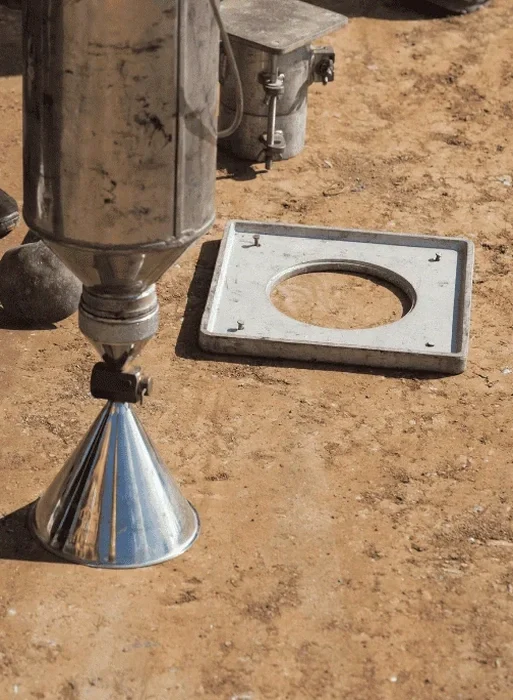
The sand cone method is a direct measurement: you excavate a hole, weigh all the removed soil, and measure the hole volume with calibrated sand. A nuclear gauge infers density from radiation backscatter or transmission. Because Honolulu’s volcanic soils sometimes contain minerals that affect nuclear readings, the sand cone remains the referee method required by most special inspection agreements and by the Honolulu Building Code for dispute resolution.
How many density tests does my Honolulu project need?
The frequency depends on the project’s geotechnical report and the special inspection program filed with the Honolulu Department of Planning and Permitting. A typical guideline is one test per 1,500 square feet per lift for building pads, and one test per 100 linear feet per lift for utility trenches. We help the special inspector adjust frequency based on fill variability observed during the first days of earthwork.
Can the sand cone test be used in saturated or very wet fill?
The reference range for this service in Honolulu is US$90 - US$160. The final price depends on the project scope and volume.