Honolulu’s ground is not textbook soil. Most jobs we see from Downtown to Kakaako hit interbedded coralline sand, residual basalt clay, or uncontrolled fill over reef limestone. Rainfall on the Ko’olau slopes averages over 200 inches per year in upper Manoa, keeping the vadose zone saturated more often than engineers expect. When a high-rise goes up on Ala Moana Boulevard or a retaining wall is planned in Nuuanu, drained and undrained strength have to be separated carefully. A triaxial test gives that separation. The test consolidates a sample under site stress, then shears it under controlled drainage. We get effective friction angle, cohesion intercept, and pore pressure response. For Honolulu’s variable geology, combining triaxial data with CPT soundings builds a continuous strength profile without relying on correlations alone.
A CU triaxial with pore pressure measurement is the only way to separate apparent cohesion from true drained strength in Honolulu’s saturated residual soils.
Scope of work in Honolulu
Typical technical challenges in Honolulu
The most expensive mistake we see on Oahu is running only UU triaxials when the design needs effective stress parameters. UU tests give total stress strength—useful for short-term stability during construction—but they don’t separate pore pressure from grain-to-grain contact. In Honolulu’s saturated clay layers, pore pressures during shear can cut effective strength by 40 percent or more. A foundation designed on UU data alone can end up with a factor of safety below 1.0 once drainage occurs. Another common failure: using remolded samples for triaxial testing on sensitive marine clay. The disturbance destroys the natural structure, and the lab reports strength that doesn’t exist in the ground. We’ve reviewed reports where the lab ran tests on obviously disturbed Shelby tube samples and still published numbers. Those numbers go straight into the foundation design. The IBC Chapter 18 and ASCE 7 requirements for site-specific geotechnical investigation apply here; a triaxial program with proper sampling and saturation is not optional when the water table sits at 3 feet.
Our services
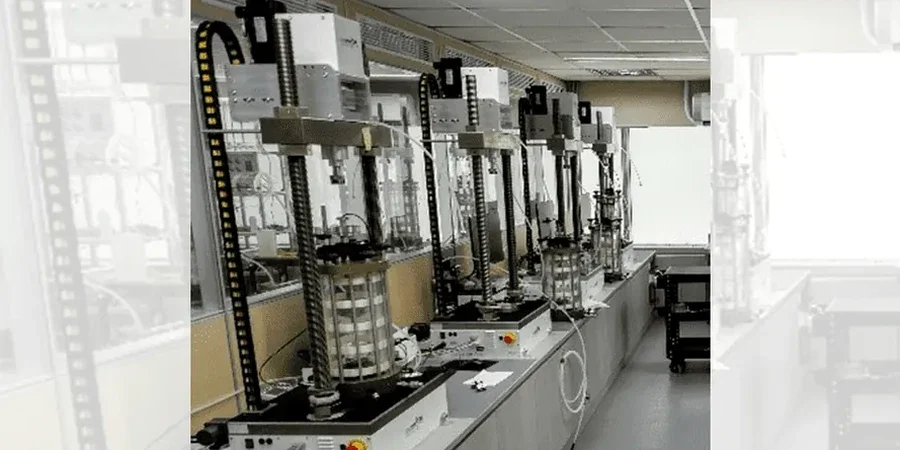
Our Honolulu lab runs triaxial programs that match the complexity of Oahu’s geology. From routine UU screening to multi-stage CU with pore pressure measurement, we configure the test to the design question.
CU Triaxial with Pore Pressure
Consolidated-undrained test per ASTM D4767. We measure excess pore pressure throughout shear and report effective stress Mohr-Coulomb parameters. Standard for Honolulu high-rise foundations and deep excavation design.
CD Triaxial for Drained Strength
Consolidated-drained test per ASTM D7181 for free-draining coralline sands and gravels. Slow shear rate ensures no pore pressure buildup. Used when long-term drained conditions control stability.
Multi-Stage Triaxial Program
Three or more specimens at confining pressures matched to overburden at different depths. We build a site-specific strength envelope instead of relying on published correlations for Honolulu’s mixed volcanic and marine sediments.
Questions and answers
What does a triaxial test cost in Honolulu?
A single triaxial test typically runs between US$1,660 and US$2,460 depending on test type (UU, CU, or CD) and confining stress requirements. A full three-specimen program with pore pressure measurement falls in the upper range. The price includes specimen trimming, saturation, shearing, and a report with Mohr-Coulomb parameters and stress paths.
How long does a triaxial test take from sample to report?
A UU test can be completed in 2–3 working days. CU tests need consolidation and slower shearing—plan on 5–7 working days. CD tests on low-permeability Honolulu clays can run 10–14 days because the shear rate must be slow enough to prevent pore pressure buildup. We time saturation and consolidation carefully; rushing this stage produces unreliable B-values.
What sample quality do you need for a reliable triaxial?
We need undisturbed samples—Shelby tubes pushed in cohesive soil, or block samples from test pits. The specimen must show no signs of desiccation, cracking, or remolding. We log sample condition upon arrival and reject tubes with visible disturbance. For Honolulu’s sensitive marine clays, sample handling between the field and our lab makes the difference between a usable strength envelope and numbers you cannot trust.
Which triaxial type is right for Honolulu’s coralline fill?
Coralline sands and gravels are free-draining, so a CD triaxial or a CU with pore pressure measurement works. If the fill is loose and below the water table—common in Kakaako and Waikiki—we recommend CU with pore pressure measurement to capture contractive behavior. UU alone will not show the effective friction angle, and you risk underestimating long-term settlement or stability.
Can you test samples from shallow depths, like 5 to 10 feet?
Yes. We regularly test samples from shallow footing depths. The confining pressure is set to match the in-situ effective stress at the sample depth. For very low confining pressures under 5 psi, we use a low-range pressure transducer and a lightweight loading piston to maintain accuracy. Shallow samples from Honolulu’s residual soils often show higher apparent cohesion from desiccation; we discuss this in the report so the design engineer applies it correctly.